The journey to Budva, the main beach resort of Montenegro, was quite interesting, with the driver having an enormous argument with some other passenger and ending with everybody having to switch buses. Not quite sure what happened there. Once in Budva I tried to book a hostel at the accommodation desk, but the astoundingly unhelpful lady didn't seem to want to facilitate this, despite it being her job, so I set off on foot and had a quick look around. I was not impressed at all, with the town crowded with tourists and a seemingly never-ending landscape of dull apartment blocks and hotels stretching along the coast. I decided to move on immediately and head to Albania.

The Albanian National History Museum
This was where, for the first time on my entire trip, things got difficult. Despite Montenegro's close proximity to Albania (they share a bloody border!), nobody seemed to know anything about actually getting there. I eventually took a bus to Podgorica, capital of Montenegro and right next to the main border crossing, certain that there'd be public transport continuing from there. This was not the case. I was told that there were no buses at all and that the railway line had closed years ago. Eventually I met a helpful taxi driver who offered to drive me to the border, for a 'cheap price' of 25EUR. I had no choice and accepted.

A closer view of that wonderful communist mural
It turned out he used to work for the Montenegrin tourist board and therefore spoke impeccable English, which was quite a pleasant surprise after my experiences earlier in the day. He explained that not many people want to travel to Albania and so the only way is by private car. We drove alongside the rusting railway line to a large and beautiful lake that marks the border. Once at the official border crossing, he negotiated with another driver and I was passed along into a crampt old car with an Albanian driver, with 5 of us squeezed inside. Little did I know this would be the scariest ride of my life, and a worthy introduction to Albanian road safety. Or, rather, the lack of.

Sunset in Tirana
He drove at speeds that must have been well over 100mph, along bumpy, poor-quality roads, overtaking on blind corners and generally ignoring anything resembling a highway code. We made the journey, which looking at my map I estimated to take a good hour, in about 30 minutes, arriving in the Albanian border town of Shkodra. This place was a real shock to me, having an almost third world appearance. Crumbling buildings, chaotic streets and a staggering lack of infrastructure. There was rubbish all over the place and random piles of it burning in roads throughout the city. Weathered old men road past on horse-pulled carts, motorcyclists, none of them wearing helmets, weaved dangerously in and out of traffic and filthy trucks drove past with people sitting on top. I attracted quite a few stares, clearly being the only foreigner around. I hopped on a Furgon, which is the main method of public transport here in Albania. Like a communal taxi, furgons are minibuses with a flat-rate fair that pick up and drop off people anywhere on their routes and continue to be a necessity throughout eastern europe and Russia.

The main square
While waiting on the furgon for more passengers to get on I saw my first traffic accident happen just metres away from me. I was amazed to see the poor old motorcyclist picked up by passers by and bundled into a car off to the hospital within seconds, leaving just a pool of blood in the road to indicate that anything had happened. Once we set off to Tirana, the capital, I counted twelve road-side shrines to accident victims in just five minutes. I have never seen a place as dangerous as this, and once again the ride was quite unnerving, with the minibus weaving in and out of traffic, overtaking on corners and having a total lack of seatbelts that I would soon need to get used to.
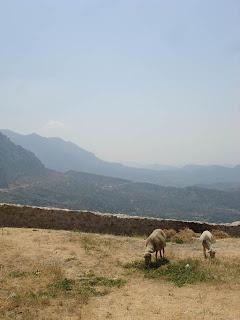
In the Albanian countryside
A couple of hours later I was dropped off in a random street on the outskirts of the centre of Tirana. Not knowing where I was, I tried to ask passers by but nobody spoke english, and the waiting taxi drivers didn't seem to want to drive me, but pointed in the direction of what I hoped was the centre. After a long walk in the heat, and not finding any hostels, I eventually found a hotel on the main square with one room left and managed to persuade them to let me have it for 25 Euro a night, which was the best I could do.

A typical village market
After a good night's sleep in a proper hotel bed, I awoke quite excited to discover this strange place I was in. A quick wander around the city found it to be quite a pleasant place indeed, if you can look past the chaotic traffic and accept that crossing the street is much like a game of Russian Roulette. All the buildings have been recently painted in bright colours, giving the city a strangely cheerful and disorientingly art deco-style look, not something I would have expected in this part of the world. What would have been a depressing place full of grey apartment blocks has had a remarkable facelift, which I later found out was thanks to the mayor, who is a former artist.

One of those lovely bright buildings
My aim of the day was to head to Kruja, a town in the countryside which came recommended as a good place to see. I eventually caught a furgon there and had a walk around the town, then headed up to the castle on the hill. Here I spotted the only other foreign tourists I saw in Albania - three of them! The castle was quite nice, but there wasn't much else to see and so I grabbed a furgon back to Tirana, on which I met a charming Albanian chef, who spoke almost no english but we managed to have a constructive conversation through the international language of waving our arms about. He explained he had been a soldier in the Albanian army and had just come back from Iraq, but said being a chef paid better!

Statue of Skanderbeg, hero of Albania
This brings me on to one of the things I most liked about Albania - the people. They really stood out, even after having just travelled through 17 countries, as collectively the nicest, friendliest, most charming people I have encountered. Despite having perhaps the least number of English speakers of anywhere I've been (with Ukraine in a close second), it really didn't seem to matter. Even if people couldn't understand me, they were very patient and tried everything they could to help. When leaving Tirana I asked a group of taxi drivers how I could get to the Macedonian border, and rather than a simple shake of the head that I expected, I soon had a team of them working together trying to find out how I could get to my destination!

Atop the clock tower looking over the main square
Albania had one of the strangest post-war histories of all the eastern european countries. Before the war they were led by the self-proclaimed King Zog (Yes, really). After the war, led by the dictator Enver Hoxha, the country was, like the rest of the region, transformed into a communist 'people's republic' with close relations first to Yugoslavia, then after falling out, with the Soviets. However, after the death of Stalin, Hoxha also fell out with the USSR and had just one friend in the world - the Chinese. Eventually they fell out with them too (I see a pattern emerging) and became one of the most isolated countries in the world. Nobody was allowed in or out, propaganda emphasised the importance of self-determination and independence and the evils of the outside world. Hoxha had over 400,000 bomb-proof bunkers built across the country as defence from the outside. Albania was, in a sense, a tiny black hole in the corner of Europe that was a mystery even to its neighbours. And in fact, it still seems to be that way today. Yes, it's now free, democratic, capitalist and making steps towards joining the EU, but it still feels like nowhere else in europe, a place few people know about and even fewer have visited.

A rather small example of those ever-present bunkers
This is what I loved most about Albania, the real sense of difference, of being somewhere few tourists go. It's just such a unique place - 90% of all cars in the country are Mercedes (just don't ask where they came from), those 400,000 large concrete bunkers still litter the country as they proved demolition-proof and despite appearances of normality in the capital, the power still goes out several times a day. This doesn't seem to be much of a problem for its residents, even in the night - within seconds generators are wheeled out and as a strange hum descends over the city, the cafes and bars stay open and people continue to get on with their lives. What a wonderful place!
Labels: Albania, Balkans, Kruja, Shkodra, Tirana
 Ohrid Castle
 On the castle walls
 An archaeological dig sight
 A beautiful sight
 This was taken from a charming fisherman's village at the cliff base
 An oversized message of support from Tito regarding a 1970s earthquake
 A typical sight. Note the Tito dedication on the sign
 Not the best destination for sightseers
 Converted railway cars now serve as bars in the old station